
Is It ADHD or Just Being 4? How to Tell the Difference | WhyTheyThink Blog
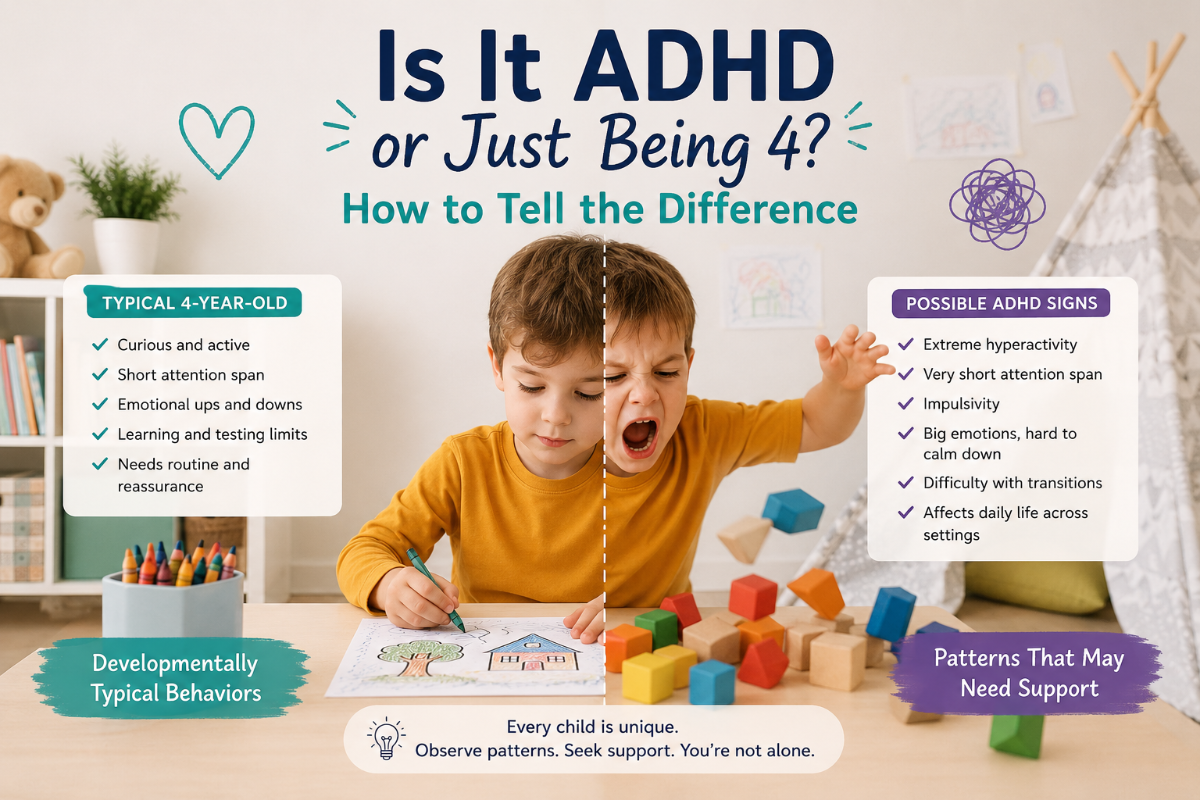
If you've ever watched your 4-year-old bounce from the trampoline to the iPad to a half-eaten snack to a meltdown over a sock, all in the space of ten minutes, you might have wondered: is this just being four, or is something else going on?
It's one of the most common questions parents bring to us, and it's a genuinely hard one. Four-year-olds are, by nature, impulsive, energetic, and not great at sitting still. So how do you tell typical preschool behaviour apart from early signs of ADHD?
Why this age is so confusing
Preschoolers are still developing the parts of the brain responsible for impulse control, attention, and emotional regulation. A certain amount of "can't sit still," "didn't think before doing that," and "completely fine one minute, devastated the next" is simply part of being four.
This is exactly why ADHD is rarely formally diagnosed before age 5 or 6. Doctors want to see a consistent pattern over time, not a snapshot of one particularly chaotic Tuesday.
But "wait and see" isn't always satisfying when you're the one living through the chaos every day, especially if you're noticing things that feel different from how other kids the same age behave.
Questions that can help you think it through
These aren't a checklist for diagnosis, but they're the kinds of questions that can help separate "typical four" from "worth keeping an eye on."
Is it about intensity, or is it about everything?
Most four-year-olds have specific triggers. They melt down at bedtime, or when a sibling takes their toy, or when they're hungry. If your child's high energy and big reactions feel more like a constant baseline rather than tied to specific moments, that's worth noting.
How does it compare to same-age peers, not older siblings or adults?
It's easy to compare your four-year-old to your eight-year-old and think "wow, so much harder." But the comparison that matters is to other four-year-olds. If you've spent time around a few (preschool pickup, playdates, daycare), does your child's activity level and impulsivity stand out as noticeably more, or does it feel within the normal range of "they're four"?
Does it shift with sleep, hunger, or routine?
Typical preschool behaviour tends to be very responsive to basic needs. A child who's wild after a missed nap but generally manageable on a good day is showing a pretty typical pattern. A child whose level of activity and impulsivity stays roughly the same regardless of sleep, food, or routine might be showing something more consistent and less situational.
Is there a pattern across different settings?
This one is particularly useful. Does daycare or preschool report similar things to what you see at home, even though the environments and adults are completely different? When a pattern shows up consistently across different settings with different people, it's less likely to be about parenting style, environment, or a particular adult's expectations, and more likely to be something about how your child's brain is wired.
Can they slow down for things they love?
A child who can sit and focus intensely on building with blocks or watching a favourite show, but cannot sit still for almost anything else, is showing a pattern that's actually quite consistent with ADHD. The issue often isn't an inability to focus. It's an inability to focus on things that aren't immediately rewarding or interesting.
What this isn't about
This isn't about labelling every energetic four-year-old. Most aren't. Most are exactly where they should be developmentally, and what feels exhausting now will look completely different by age six or seven.
It's also not about waiting anxiously for something to be "wrong." Plenty of four-year-olds who show some of these signs go on to have no further concerns at all. Development at this age is genuinely uneven and unpredictable.
What it is about is paying attention to your own observations. You know your child better than anyone, and if something has been nagging at you for months, that's information worth taking seriously, even if everyone tells you "they're just four."
What to do with what you're noticing
If some of this feels familiar, a few things can help:
Start writing things down. Not to build a case, just to notice patterns over a few weeks. When does it happen? How long does it last? What helps?
Talk to your child's preschool or daycare educators. They see your child in a completely different context and often have useful, non-judgmental observations.
Consider a screening. A free screening can't diagnose anything, but it can help you put words to what you're noticing and give you a clearer picture of whether what you're seeing lines up with patterns associated with ADHD or other neurodevelopmental differences. It can also be a useful starting point if you do decide to talk to your doctor.
The bigger picture
Most four-year-olds who are a lot are just being four. But "most" isn't "all," and trusting your own observations is never the wrong move. Whether the answer turns out to be "this is completely typical" or "this is worth exploring further," having more clarity is almost always better than sitting with an unanswered question.
If you're curious about how your child's patterns compare across attention, activity, and emotional regulation, our free screening covers all of these areas and gives you a starting point, whatever the answer turns out to be. You can also read more about what ADHD can look like in young children if you want to understand the broader picture.
Related articles
- Twice-Exceptional (2e): What It Means to Be Gifted and Neurodivergent | WhyTheyThink Blog
Twice-exceptional (2e) individuals are both gifted and neurodivergent, often excelling in some areas while facing learning challenges. Learn what 2e means, signs to look for, and how to support them effectively.
- Why Does My Child Overreact to Clothing Tags? | WhyTheyThink Blog
Some children melt down over scratchy tags, tight socks, or noisy rooms and it's not defiance. Here's what sensory overreaction actually looks like and what might be behind it.
- How to talk to your child's teacher about ADHD | WhyTheyThink Blog
Talking to your child's teacher about ADHD concerns doesn't have to be uncomfortable. Here's how to prepare, what to say, and how to keep the conversation productive.