
Signs of dyslexia in a 7 year old | WhyTheyThink Blog
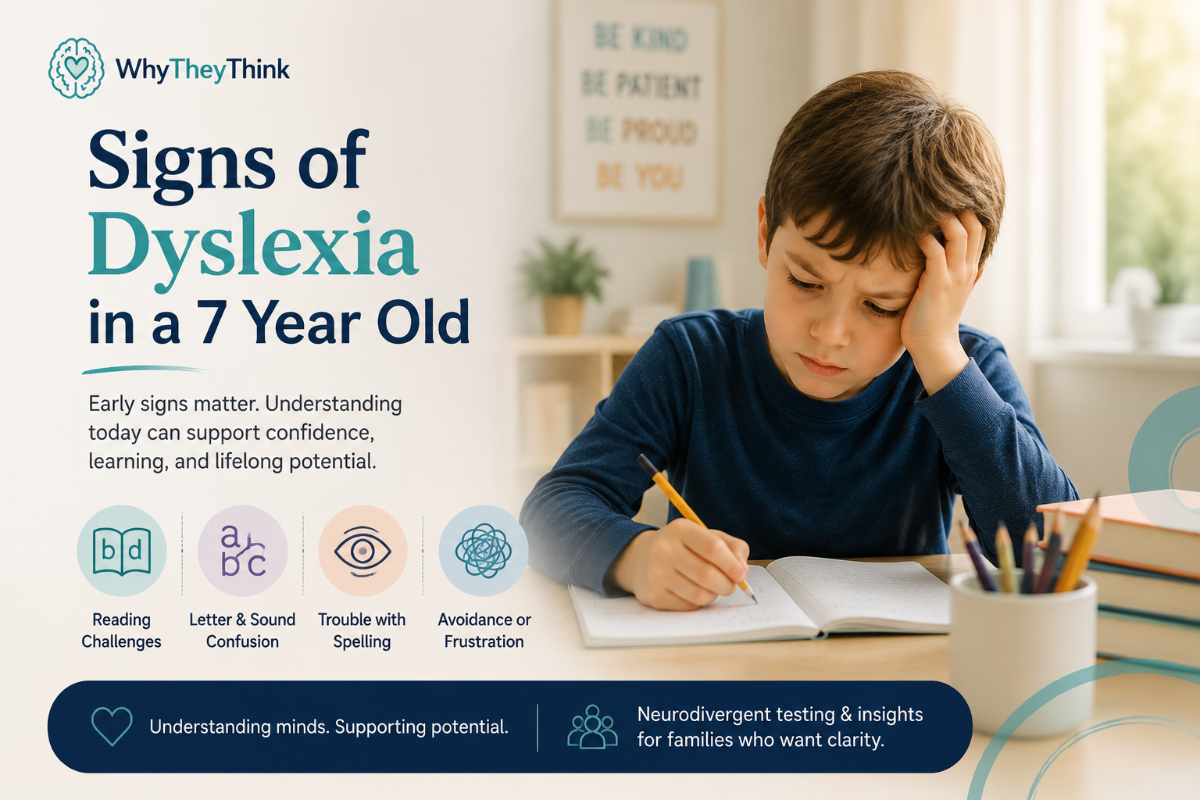
Signs of Dyslexia in a 7-Year-Old
Seven is the age when reading differences start to become visible. Kindergarten is behind them. The expectation now is that children read, not just sound out simple words, but actually read. And for children with dyslexia, this is often the year when the gap between what they can do and what's expected of them begins to show up clearly.
That gap doesn't mean your child isn't intelligent or isn't trying. It means their brain processes written language differently, and that difference responds very well to early, targeted support. The key is knowing what to look for.
Learn more about dyslexia here.
What Reading Should Look Like at Seven
By age seven, most children are consolidating early reading skills. They can sound out short, unfamiliar words using phonics they've been taught. They recognize common sight words without sounding them out every time. Reading is still effortful, but there's forward momentum. Books are getting longer. Confidence is building.
That doesn't mean every seven-year-old reads at the same level. There's a wide range of what's typical. But children who are developing normally, even those on the slower end, will show steady progress as the year goes on.
When a child with dyslexia doesn't show that progress, it's not because they haven't worked hard enough. It's because the reading instruction they've received, even good instruction, isn't connecting the way it does for most children.
Signs That May Point to Dyslexia at Seven
No single sign confirms dyslexia on its own, and some variation is completely normal at this age. What you're looking for is a pattern, several of these things showing up consistently, not as a one-off bad day.
Reading is slow and effortful, even on familiar words
Your child has read the same books repeatedly but still reads them haltingly, word by word. There's no fluency building. Friends who started at the same level are moving ahead, and your child is working just as hard but not keeping up.
Sounding out new words is a struggle
When they hit an unfamiliar word, they freeze, guess based on the first letter, or skip it entirely. The phonics strategies they've been taught don't seem to stick the way they do for other children.
Spelling is inconsistent in a specific way
This is one of the clearest early signs. A child who is a late reader but not dyslexic will often spell words wrong in a way that still makes phonetic sense. A child with dyslexia might spell the same word three different ways on the same page, or spell it correctly in one sentence and completely differently two lines later. The pattern doesn't hold.
Letter reversals that are still frequent
Reversing b and d, or p and q, is common and normal in kindergarten. By seven, most children have sorted this out. If reversals are still happening frequently and across multiple letters, it's worth noting, particularly alongside other signs on this list.
Reading aloud is much harder than reading silently
They can sometimes follow along or understand more when they read to themselves, but reading aloud is stressful and significantly more difficult. They lose their place, skip words, or guess at words rather than sounding them out.
Strong comprehension when listening, weak comprehension when reading
Read a passage to them and they understand it well. Ask them to read it themselves and they can't follow the meaning because all their mental energy is going into decoding the words. This gap between listening comprehension and reading comprehension is a hallmark of dyslexia.
They are verbally capable but written work doesn't reflect it
In conversation, your child is sharp. They tell detailed stories, use interesting vocabulary, and reason well. But put a pencil in their hand and something gets lost. Written sentences are short, simple, or avoided entirely.
They have started avoiding reading
Books they would have shown some interest in before are now dismissed. They resist reading homework, take a long time to get started, or complain of headaches and stomachaches when it's time to read. Avoidance at this age is usually a signal that reading feels like failure, not just difficulty.
What Doesn't Point Specifically to Dyslexia
Not everything that looks like a reading problem is dyslexia. A few things worth ruling out first:
- Vision problems that make it physically hard to track text
- Hearing difficulties that have affected phonological awareness development
- Limited exposure to books and reading at home in early childhood
- Anxiety or attention difficulties that make it hard to settle and focus during reading tasks
Some of these can coexist with dyslexia. Others can look like dyslexia but resolve with different support. A conversation with your child's doctor about vision and hearing is a reasonable early step if you haven't already had one.
What You Might Be Hearing from the School
Schools vary enormously in how early they flag reading concerns. Some have strong screening programs and will come to you. Others tend toward a "wait and see" approach that can be frustrating when you can see the difficulty clearly at home.
Common things parents hear that are worth questioning:
"He's just a late bloomer." This can be true. It can also be a way of deferring a difficult conversation. The question to ask is: what specific data shows progress over the last term?
"She'll catch up." Possibly. But without understanding why she's behind, there's no way to know whether the right support is in place to make that happen.
"Boys read later than girls." There's some variation in development across genders, but significant, persistent reading difficulty in a seven-year-old boy is still worth investigating, not waiting out.
If your instinct is that something is being missed, you're allowed to push for more information. Ask what reading assessment data the school has, what the intervention plan looks like, and what the timeline is for reviewing progress.
What Dyslexia Is Not
Because the myths still circulate widely, it's worth being direct about a few of them.
Dyslexia is not a sign of low intelligence. Many highly intelligent people have dyslexia. The two have no relationship.
Dyslexia is not seeing letters backwards. Some children with dyslexia do reverse letters, but that's not the defining feature. It's a language processing difference, not a visual one.
Dyslexia is not something children grow out of with enough time. Without specific, structured literacy instruction, the gap tends to grow, not close. Early support makes a genuine difference to outcomes.
Why Seven Is an Important Age to Act
The research on early literacy intervention is consistent: the earlier structured support begins, the better the outcomes. The brain's plasticity for language learning is at its highest in the early school years. Intervention at seven or eight has a significantly stronger effect than the same intervention at ten or eleven.
That doesn't mean it's too late if your child is older. It isn't. But if you're reading this and your child is seven, you are in a window where acting now matters.
What to Do Next
Start with your child's teacher. Ask for specific reading assessment data, not a general impression. What is their reading level? How does that compare to expectations for their age? Is there data showing progress over time?
If concerns are confirmed, ask about a referral for a psychoeducational assessment. This is the formal evaluation that can identify dyslexia and other learning differences. In most Canadian provinces and many US states, schools are required to provide assessment support, or at least referral pathways, when a child is demonstrably struggling.
A screening is also a useful starting point before those conversations. It won't diagnose dyslexia, but it can help you see whether the pattern of difficulty you're noticing aligns with a dyslexia profile, and give you clearer language to bring to your child's teacher and doctor. See if a pattern shows up: free screening, no signup required.
Related articles
- Why Does My Child Overreact to Clothing Tags? | WhyTheyThink Blog
Some children melt down over scratchy tags, tight socks, or noisy rooms and it's not defiance. Here's what sensory overreaction actually looks like and what might be behind it.
- Twice-Exceptional (2e): What It Means to Be Gifted and Neurodivergent | WhyTheyThink Blog
Twice-exceptional (2e) individuals are both gifted and neurodivergent, often excelling in some areas while facing learning challenges. Learn what 2e means, signs to look for, and how to support them effectively.
- How to talk to your child's teacher about ADHD | WhyTheyThink Blog
Talking to your child's teacher about ADHD concerns doesn't have to be uncomfortable. Here's how to prepare, what to say, and how to keep the conversation productive.